Medically reviewed by Paul G. Kiritsis, MD | Reviewed August 2026
The subscapularis isn’t a muscle most patients know by name, but it’s one I pay close attention to when planning shoulder surgery. Whether I’m performing a shoulder replacement or treating shoulder instability, the way I manage the subscapularis is an important part of restoring shoulder function. In this post, I’ll explain why it matters and what patients should know before and after surgery.
Key Takeaways
- The subscapularis has to be detached to reach the joint during most shoulder replacements, which means how it’s repaired afterward has a direct effect on your recovery and long-term function.
- A torn or poorly healed subscapularis is a common, and often overlooked, cause of ongoing weakness and instability after shoulder surgery.
- I’ve built subscapularis management into a specific focus of my surgical technique, including a repair method I’ve developed to try to improve how reliably it heals.
A Quick Refresher on What the Subscapularis Does
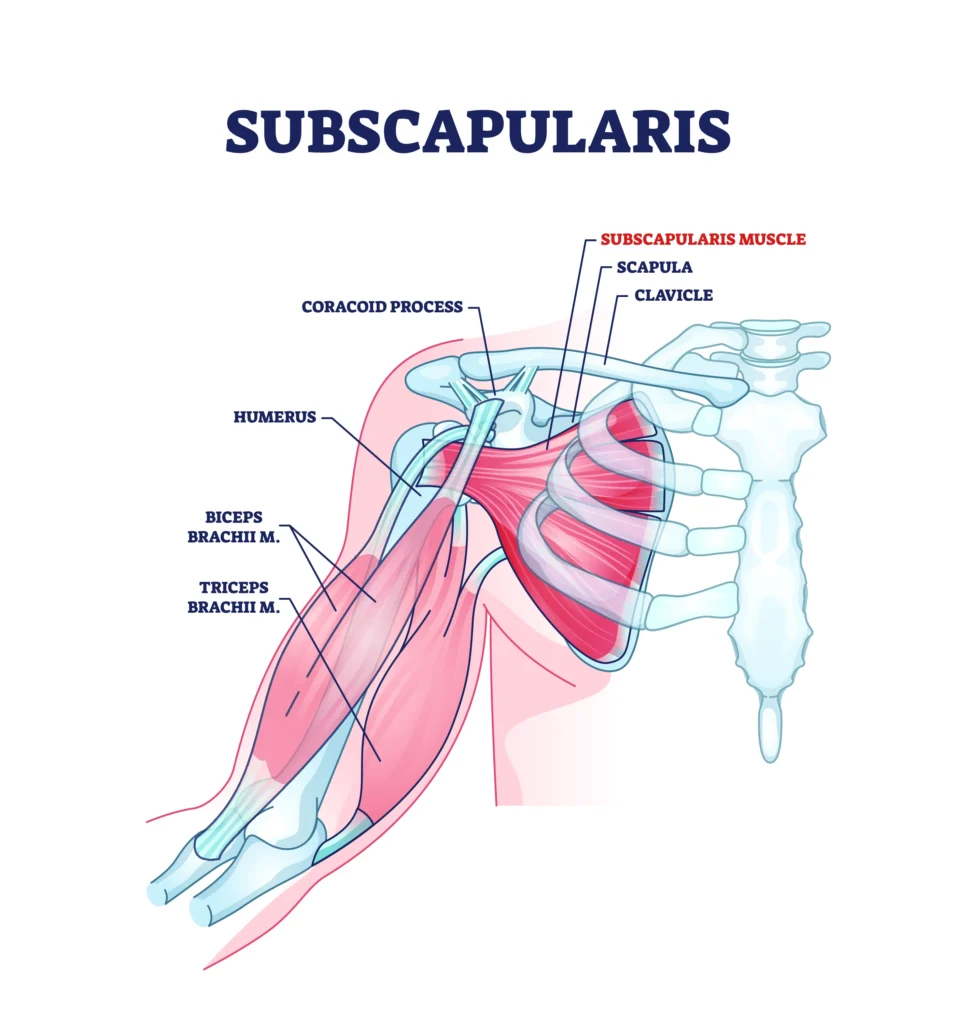
The subscapularis sits on the front surface of the shoulder blade and attaches to the top of the arm bone. Its job is to internally rotate the arm and help hold the ball of the shoulder centered in the socket. Of the four rotator cuff muscles, it’s the largest and generates a substantial share of the total force acting on the joint.
If you want the full anatomical breakdown, including the nerves, blood supply, and common injury patterns, I’ve covered that in detail in my post on “What does the subscapularis do?” Here, I want to focus on the part that matters most once someone is heading toward surgery.
What I See in My Patients
Two very different groups of patients bring the subscapularis into my office. The first are athletes and active adults with shoulder instability, often after a dislocation, where the subscapularis has been stretched or torn. A tear here reduces the muscle’s ability to hold the humeral head centered, which can make a shoulder feel loose or prone to slipping, especially with the arm rotated outward and raised overhead.
The second group are patients heading toward a shoulder replacement, where the subscapularis has to be managed surgically almost regardless of what’s causing their arthritis. In my experience, patients rarely connect the two. Someone scheduled for a total shoulder replacement is usually focused on the arthritis itself, not on a tendon they’ve never heard of. Part of my job during the consultation is explaining that the subscapularis is going to be taken down to get to the joint, and that what happens to it afterward matters.
Why the Subscapularis Is a Key Structure in Shoulder Replacement
Most shoulder replacements go in through the front of the shoulder. To get to the joint, the subscapularis tendon has to be released and then repaired at the end of the case. This is standard. What varies quite a bit from surgeon to surgeon is how that repair is done and how well it holds up.
If the subscapularis fails to heal properly after surgery, patients may notice it. Internal rotation weakness, difficulty tucking in a shirt, a sense that the shoulder isn’t quite as stable as it should be, and in some cases outright instability of the new joint can all trace back to a subscapularis repair that didn’t hold. I consider this one of the more preventable causes of a disappointing outcome after an otherwise well-done replacement, which is exactly why I’ve put so much focus into it.
I’ve made subscapularis management a specific focal point of my surgical approach, and I hold a patent-pending repair technique aimed at improving how reliably the tendon heals back to bone.
A Different Calculation with Reverse Shoulder Replacement
The subscapularis plays a specific role when I’m doing a reverse total shoulder replacement, which I typically reserve for patients with a large, irreparable rotator cuff tear alongside their arthritis. Because the reverse design relies on the deltoid muscle rather than the rotator cuff to power the arm, an intact subscapularis becomes less critical for elevation. Even so, I may still repair it when the tissue allows, since a functioning subscapularis may help reduce the risk of the joint dislocating anteriorly after surgery.
Deciding whether to repair it, and how, is one of several judgment calls that separates a reverse replacement plan from a standard one, and it’s a conversation I have with every patient before we settle on which procedure fits their shoulder.
How I Evaluate the Subscapularis Before Surgery
A physical exam tells me a lot. Multiple tests can stress the subscapularis in a slightly different way, and taken together they give a reasonably clear picture of whether the tendon is intact, partially torn, or significantly compromised. When surgery is on the table, I lean on MRI to look specifically at tendon quality and the amount of fatty infiltration in the muscle, since a subscapularis that’s been torn for a long time behaves differently in surgery than one injured recently. That distinction shapes the repair strategy well before I’m in the operating room.
Protecting the repair afterward matters just as much as getting it right during surgery. Patients wear a sling for several weeks following a shoulder replacement specifically to protect the healing subscapularis, and I ask patients to avoid pushing against resistance with the arm rotated inward, like shoving open a heavy door, until the tendon has had adequate time to heal. Rushing this step is one of the more common, and most avoidable, ways a good repair gets undone.
Summary
The subscapularis rarely gets top billing when patients think about shoulder surgery, but in my experience it’s one of the structures most likely to quietly determine how a good result becomes a great one. Whether you’re facing a shoulder replacement or dealing with instability after a dislocation, ask your surgeon directly how the subscapularis will be managed and repaired. If you’d like me to walk through that plan for your specific shoulder, call my Midlothian office at (804) 939-6651 or schedule an appointment online.
Frequently Asked Questions
Why does the subscapularis have to be cut during shoulder replacement?
Most shoulder replacements use an anterior approach, meaning the surgeon enters through the front of the shoulder. The subscapularis tendon sits directly in the path to the joint, so it has to be released and then repaired once the implant is in place.
What happens if a subscapularis repair doesn’t heal?
Patients may notice internal rotation weakness, difficulty with tasks like tucking in a shirt, or a sense of instability in the new joint. This is one of the more preventable complications after shoulder replacement, which is why the repair technique matters.
Can a subscapularis tear cause shoulder instability on its own?
Yes, particularly anterior instability, since the subscapularis normally helps keep the humeral head centered in the socket. It often occurs alongside a labral tear rather than in isolation.
Is subscapularis repair always done arthroscopically?
Not always. Isolated subscapularis tears can often be repaired arthroscopically, but during a shoulder replacement, the repair is typically done as part of the open approach used for the arthroplasty itself.