

Patients walk into my Midlothian office all the time describing a shoulder that “popped out” and ask whether that means it dislocated. Not necessarily. Shoulder subluxation vs. dislocation comes down to how far the ball of the joint actually travels out of the socket. While the two injuries share many symptoms, they differ in severity, treatment, and the likelihood of future instability. Understanding that distinction can help you know what to expect if your shoulder slips out again.
Key Takeaways
- A subluxation is a partial, temporary slip of the shoulder out of its socket that returns on its own; a dislocation is a complete separation that usually needs a medical professional to put it back in place.
- Both injuries stretch or tear the same ligaments and cartilage, so a subluxation can be just as important to treat as a full dislocation, especially if it keeps happening.
- Once your shoulder dislocates or subluxes even once, the odds of it happening again go up substantially, particularly if you’re young or play contact or overhead sports.
The Anatomy Behind an Unstable Shoulder
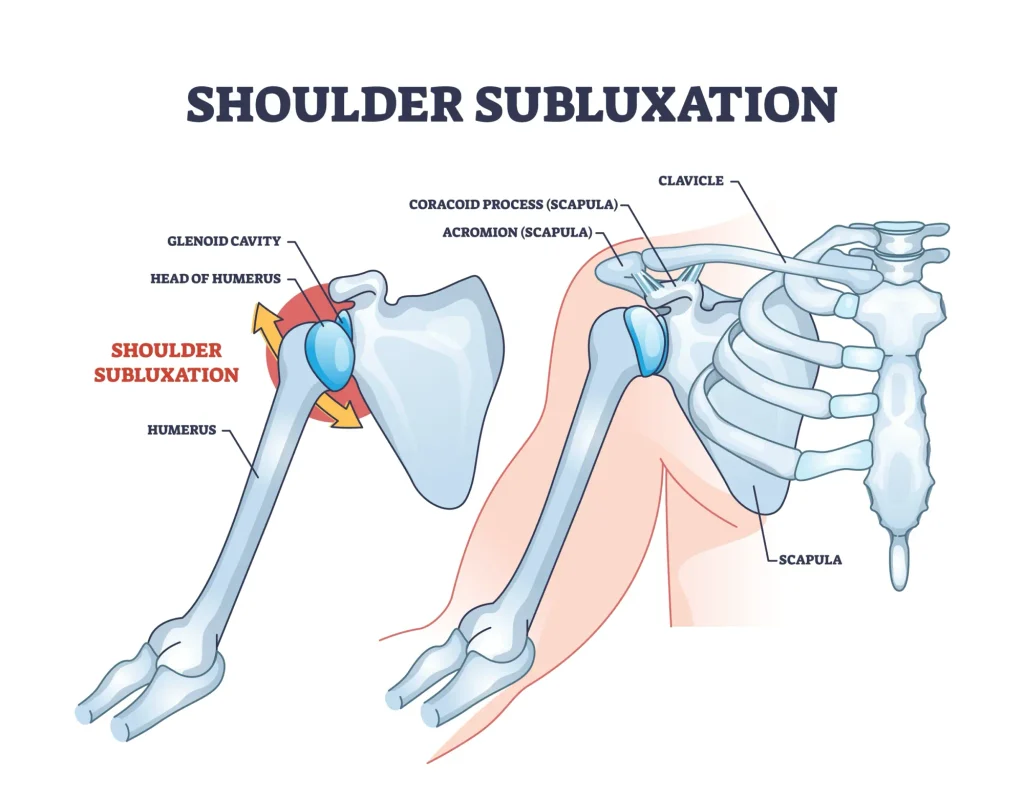
The shoulder is a ball-and-socket joint, but the socket, called the glenoid, is shallow and flat compared to the hip. A ring of cartilage called the labrum deepens that socket, and a group of ligaments forms a capsule around the joint to hold everything together.
Because the socket is so shallow to begin with, the shoulder has more range of motion than almost any other joint in the body. That mobility comes at the cost of stability, which is exactly why the shoulder dislocates far more often than the hip or knee ever does. The rotator cuff muscles add another layer of protection, working constantly in the background to keep the humeral head centered in the glenoid during everyday reaching, lifting, and throwing motions. When those muscles fatigue or weaken, the ligaments and labrum end up absorbing more stress than they are built to handle.
Subluxation vs. Dislocation: What Actually Happens
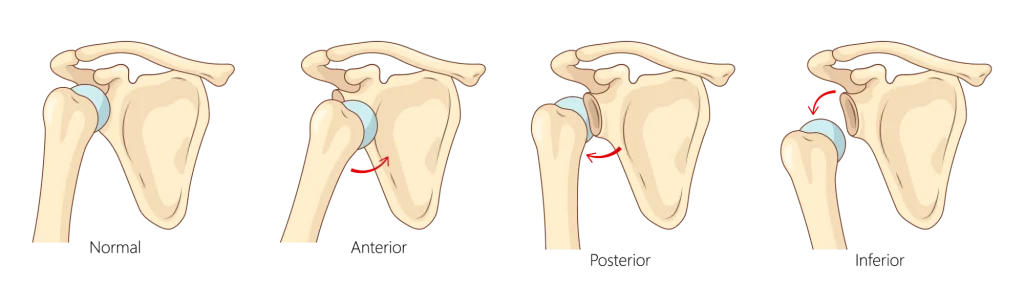
In a shoulder subluxation, the head of the humerus slips partially out of the glenoid and then slides back into place, often on its own. It’s common in overhead athletes, especially throwers, swimmers, and volleyball players, who repeatedly stress the same ligaments until they loosen. A shoulder dislocation goes a step further. The humeral head comes completely out of the socket and stays out until someone reduces it, either on the sideline or in an emergency room. Most dislocations happen in the anterior, or forward, direction.
Who’s at Risk
Age is one of the strongest predictors of recurring shoulder instability. Athletes under 20 who dislocate for the first time face an increased chance of it happening again, sometimes with less and less force each time. Contact sports raise that risk further, since every tackle or fall is another opportunity to stretch the same already-loosened tissue.
Overhead athletes face a different kind of risk. Repetitive motions like pitching, serving, or swimming strokes gradually stretch the joint capsule without any single traumatic event, which is why some of my patients develop subluxation with no memory of an actual injury at all.
A smaller group of patients has naturally loose connective tissue throughout their body, which makes the shoulder joint capsule too lax from the start. These patients tend to have instability in both shoulders, and sometimes other joints too, which changes how I counsel them about long-term management and surgical timing.
What I See in My Patients
The Richmond Kickers players I treat tend to sublux during a specific arm position, usually overhead or fully rotated outward, and they’ve often learned to work around it rather than mention it. That’s one of the more frustrating patterns I run into. Athletes will quietly adjust their throwing motion or their positioning to avoid the vulnerable spot instead of getting the shoulder looked at. A true dislocation is much harder to ignore. Those patients usually come straight from the sideline or the emergency room, holding the arm against their body because any movement is excruciating.
Symptoms That Tell Them Apart
A subluxation typically causes a quick, sharp sensation of the joint slipping or catching, sometimes followed by brief numbness or weakness down the arm, and then the shoulder looks and moves normally again within seconds. A dislocation looks and feels dramatically different. The shoulder often appears visibly out of place, sometimes squared off instead of rounded, and any attempt to move the arm causes severe pain until the joint is reduced.
Some patients also notice numbness along the outside of the upper arm after a dislocation, which usually points to a stretched nerve rather than permanent damage, though I still check it carefully at every visit until it resolves.
Diagnosing the Difference
History and a hands-on exam tell me most of what I need to know. I check for an apprehension sign, where moving the arm into a certain position makes the patient feel like the shoulder is about to slip out, which points toward instability whether or not a full dislocation has actually occurred. X-rays confirm a dislocation and rule out fractures, and I’ll order an MRI when I need a clearer picture of the labrum and ligaments, particularly before considering surgery.
I also pay attention to which direction the instability runs. Most of the shoulders I see are anterior, meaning the humeral head slips forward, but some patients have posterior instability, which behaves differently and is easy to miss on a routine exam. A smaller subset has multidirectional instability, where the joint capsule is loose in more than one direction at once. Getting the direction right can change which surgical approach I recommend, so I don’t skip this step even when a diagnosis seems obvious.
My Approach to Treatment
For a first-time subluxation, I usually start with physical therapy aimed at strengthening the rotator cuff and the muscles around the shoulder blade, since that combination does most of the work of keeping the joint centered.
A first-time dislocation gets reduced right away, followed by a period in a sling, and I lean toward physical therapy first here too, unless someone is young and playing a contact or overhead sport, where the recurrence risk is simply too high to ignore. When instability keeps recurring, whether from repeated subluxations or repeated dislocations, I may recommend a Bankart repair to reattach the torn labrum and tighten the capsule.
For shoulders with a redundant, overly stretched capsule rather than a discrete labral tear, tightening the capsule itself, a procedure called a capsular shift, may be the better fix. I walk every patient through both the nonsurgical and surgical paths honestly, because a young, high-demand athlete and a middle-aged recreational athlete often land on different decisions even with the exact same imaging findings.
Recovery and Return to Sport
Nonsurgical recovery from either injury generally takes six to eight weeks before returning to activity, once strength and control are back and the apprehension is gone. After a Bankart repair, I keep patients in a sling for about four weeks, and I don’t clear athletes to return to their sport until somewhere between six and nine months out, once they’ve passed strength testing and completed a sport-specific throwing or return-to-play program.
Left untreated, chronic shoulder instability doesn’t just mean living with an occasional scare. Repeated episodes gradually wear down the cartilage lining the joint, and over years that pattern can lead to early arthritis. That’s a big part of why I encourage patients to get an unstable shoulder evaluated well before it’s dislocated a dozen times, rather than treating each episode as a separate, unrelated event.
Summary
If your shoulder has slipped out of place even once, whether it snapped right back into position or needed help getting there, it’s worth getting it evaluated rather than waiting to see if it happens again. Schedule a visit so I can examine the joint, check for labral or ligament damage, and build a plan that addresses why it’s unstable in the first place.
Frequently Asked Questions
Can a shoulder subluxation turn into a full dislocation?
Yes. The same loose ligaments and stretched capsule that allow a subluxation can eventually let the joint come all the way out, especially without any strengthening or rehab in between episodes.
Do I need surgery for a shoulder subluxation?
Not usually the first time. I typically start with physical therapy and reserve surgery for shoulders that keep subluxing despite a real strengthening effort.
How can I tell if my shoulder dislocated or just subluxed?
A dislocation usually looks visibly out of place and stays that way until someone puts it back, while a subluxation slips and returns to normal within seconds. If you’re unsure, it’s worth getting examined either way.
What’s the recurrence rate after a first shoulder dislocation?
It can be high, especially in patients under 20, where a majority end up with another dislocation. Age, activity level, and how the shoulder was initially treated all affect that risk.