

In my Richmond and Midlothian practice, I see far more ACL tears than PCL tears. Because ACL injuries get so much attention, many patients are surprised to learn that the PCL can tear too. Comparing a PCL tear vs. ACL tear comes down to how each ligament gets hurt, what it feels like afterward, and whether surgery ends up being the right call.
Key Takeaways
- A PCL tear usually comes from a direct blow to the front of a bent knee, like a dashboard injury or a hard fall, while an ACL tear typically happens from twisting, pivoting, or landing awkwardly.
- PCL tears are less common than ACL tears and often heal without surgery, but a torn ACL usually needs reconstruction especially if you want to return to cutting sports.
- Both injuries can lead to long-term knee instability if they’re ignored, which is why an accurate diagnosis matters as much as the treatment plan that follows it.
How These Two Ligaments Differ
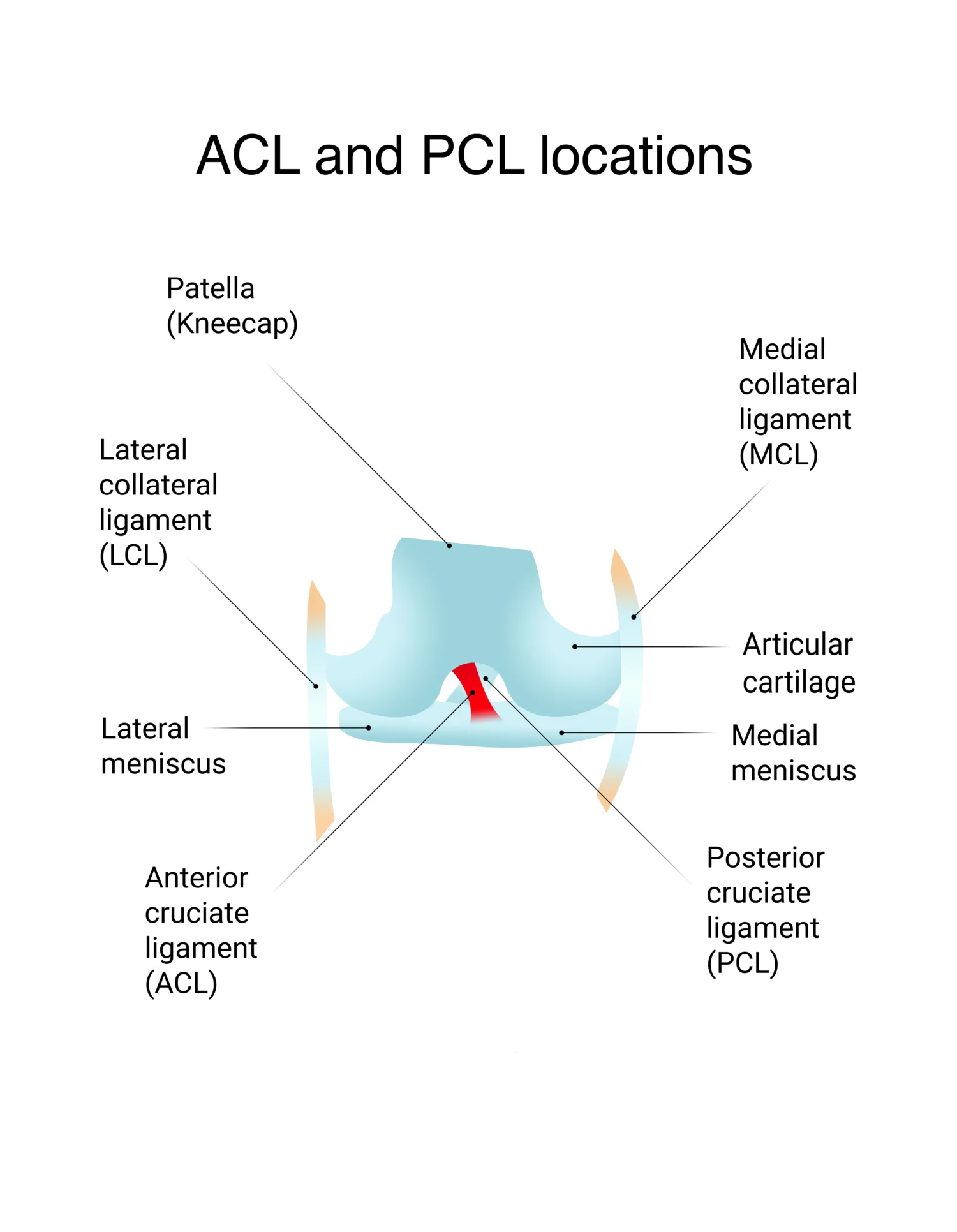
Your knee relies on four main ligaments to stay stable, and the anterior cruciate ligament (ACL) and posterior cruciate ligament (PCL) cross each other in the center of the joint, forming an X shape. The ACL sits toward the front of the knee and controls how far the shin bone slides forward under the thigh bone. The PCL sits toward the back and does the opposite job, resisting backward movement of the shin bone. Because they control opposite motions, the injuries that damage them tend to be opposite too.
What I See in My Patients
Most of the PCL tears I treat come from car accidents or sports falls where the knee strikes something hard while bent, like a soccer player landing directly on a flexed knee. ACL tears show up constantly in my Richmond Kickers players and other cutting-sport athletes after a hard pivot or an awkward landing, even with no contact involved at all. When a patient tells me they heard a pop while planting their foot to change direction, I’m already thinking ACL before I’ve even touched the knee. When someone describes hitting their knee on a dashboard or falling hard onto a bent knee, PCL moves to the top of my list.
Symptoms and Diagnosis
Symptoms overlap enough that you can’t diagnose either injury by feel alone. Both cause swelling and a sense that the knee wants to give way, especially when changing direction. That overlap is why a hands-on exam matters more than symptoms. During the exam, I check how far the shin bone shifts forward and backward relative to the thigh bone. A PCL tear lets the shin sag backward when the knee is bent, which I can check with a posterior drawer test. An ACL tear generally allows too much forward movement, which shows up on a Lachman test. An MRI usually confirms which ligament is torn and rules out damage to the meniscus or other ligaments.
How These Tears Are Graded
Not every PCL or ACL tear is created equal, and the grade matters just as much as which ligament is involved. Many orthopedic specialists use a three-grade scale, from grade 1, a mild stretch that leaves the ligament intact, to grade 3, a complete tear where the fibers have separated. In my experience, a grade 1 sprain of either ligament usually responds well to rest, bracing, and physical therapy alone. A grade 3 ACL tear, on the other hand, generally needs reconstruction if you want to get back to pivoting sports without your knee buckling on you.
Grade 3 PCL tears play by slightly different rules. Because the PCL is thicker and stronger than the ACL, even some complete PCL tears can be managed nonsurgically, especially when there’s no other ligament damage involved. I grade the tear on MRI before talking treatment, since guessing off symptoms alone tends to over- or underestimate how serious things really are.
My Approach to Treatment
I treat these two injuries very differently. An isolated PCL tear frequently heals with bracing and a focused physical therapy program, and I’ve had good outcomes managing partial and even some complete PCL tears without surgery. An ACL tear is a different story. If you want to keep playing pivoting sports, I usually recommend reconstruction, because an ACL-deficient knee tends to keep damaging the meniscus and cartilage with every twist. Either way, I’ll typically start a patient on pre-operative physical therapy first, since a knee that bends and straightens fully before surgery scars less and recovers faster afterward.
Recovery Expectations
Nonsurgical PCL recovery generally runs six to eight weeks before returning to sport, once quadriceps strength catches up and the knee stops giving way. ACL and PCL reconstructions both follow a longer road. I ask my athletes to plan on nine months before a full return to competitive sport, even if the knee feels ready sooner. That timeline isn’t arbitrary; it reflects how long a graft actually takes to mature and how long the surrounding muscles need to relearn how to protect the joint.
Lowering Your Risk on the Field
Neither injury is fully avoidable, but a few habits can help lower the odds. I tell my Richmond Kickers players the same thing I tell weekend athletes: a proper dynamic warm-up, consistent strength training for the muscles around the knee, and the right protective gear for contact sports all seem to reduce how often both ACL and PCL injuries happen. Quad and hamstring strength in particular seems to matter, since well-conditioned muscles help absorb forces that would otherwise land straight on the ligaments.
None of this guarantees you won’t tear something. But athletes who walk into my office having done this kind of prep tend to have an easier recovery, even when they do get hurt.
Summary
If you’ve hurt your knee and you’re not sure whether it’s your ACL, your PCL, or something else entirely, don’t guess based on symptoms alone. Schedule an exam so I can run the specific ligament tests that tell the two apart, and we’ll build a recovery plan around what’s actually torn.
Frequently Asked Questions
Can a PCL tear heal without surgery?
Yes. Many isolated PCL tears heal well with bracing and physical therapy, especially milder grades. More severe tears, or ones combined with other ligament damage, usually need reconstruction.
Is a PCL tear more or less serious than an ACL tear?
Neither is automatically “worse.” PCL tears are less common and more often manageable without surgery, but a PCL tear combined with other ligament damage can be more complex to treat than an isolated ACL tear.
How long does it take to recover from a PCL tear?
Nonsurgical recovery typically takes six to eight weeks. If reconstruction is needed, I generally have athletes plan for about nine months before returning to sport.
What does a PCL tear feel like compared to an ACL tear?
Both can cause swelling, stiffness, and a feeling of instability. An ACL tear more often causes a dramatic pop and immediate swelling from bleeding in the joint, while PCL symptoms can be subtler at first.
Can I injure my ACL and PCL at the same time?
Yes. This happens most often in high-energy injuries like car accidents or serious falls, and it usually requires a more involved surgical and rehab plan than an isolated tear.